Media
Releases, charts and background for reporters and analysts covering the Stablecoin Field Guide. Everything on this page may be quoted or reproduced with credit to the Stablecoin Field Guide, FinTech Rising.
Release: October 27, 2026
Stablecoins Hold the Adoption Lead; Tokenized Money Made the Biggest Moves
Q3 2026 Digital Money Adoption Index: 13 of 15 institutional use cases advanced in 2026, with tokenized bank and clearinghouse instruments moving forward on the adoption scale.
October 27, 2026
CHICAGO — Stablecoin payments remain the most adopted form of digital money among U.S. institutions, but tokenized Treasuries, deposits and collateral made the largest adoption gains of 2026 so far, according to the third-quarter Digital Money Adoption Index published today by the Stablecoin Field Guide, a new FinTech Rising publication.
“The headlines early this year were about stablecoins, and the evidence says stablecoins still lead. But by the third quarter, institutional money began moving into tokenized deposits and collateral, instruments that banks and clearinghouses already control,” said Collin Canright, editor of the Stablecoin Field Guide. “It’s a defensive move as much as an opportunity: build the settlement plumbing first and decide later which form of money runs on it.”
Cross-border B2B payments lead the index at 65.8, up 2.5 points, and remain the one use case the Field Guide’s viability analysis rates a clear win for stablecoins against an incumbent rail. The largest moves are:
- Collateral at futures clearinghouses rose 5.0 points to 43.3 after J.P. Morgan posted tokenized collateral as CME margin in DTCC’s July 15 tokenization production event, moving the use case from Innovator to Early Adopter stage.
- Tokenized Treasuries rose 4.1 points to 60.8 on documented fund flows and collateral acceptance.
- Tokenized bank deposits rose 3.3 points to 55.0 and changed stage in the second quarter, as Kinexys and Partior transaction volumes showed in published research.
- Stablecoin debit and prepaid cards and agentic, machine-to-machine payments each rose 3.3 points, the latter from the second-lowest base on the index.
The two use cases that changed adoption stage during the year were both tokenized bank or clearinghouse instruments. The payments use cases moved, but within their adoption stages.
For scale, Allium’s third-quarter report, published October 15, counts $482 billion in stablecoin payments in the first nine months of 2026 out of $97.9 trillion in raw on-chain stablecoin transfers; the rest is exchange, DeFi, automated, and infrastructure flow. The U.S. ACH Network moved $93 trillion in all of 2025.
“Stablecoins solve real friction in cross-border payments, and that’s where they win. Everywhere else, the constraint isn’t the technology,” Canright said. “Corporate and institutional financial professionals are still learning the vocabulary. And the bankers planning and building these products say the missing pieces are customer demand and a business case, not rails.”
The GENIUS Act, signed in July 2025, takes effect January 18, 2027. The Office of the Comptroller of the Currency finalized its rule for issuers under its supervision on October 21. Rules from the Treasury Department, the FDIC, the Federal Reserve, the NCUA, and FinCEN remain proposed. As a result, the Regulatory clarity dimension for the core U.S. payment-stablecoin use cases did not move in the index between the first and third quarters.
The index scores 15 institutional use cases on a 0–100 scale from six dimensions of documented evidence: market evidence, institutional engagement, regulatory clarity, infrastructure readiness, revenue and business case, and customer demand. Between the first and third quarters of 2026, 13 use cases rose and two were flat. None fell.
“The index is based on evidence in published research documents, in the quarter it publishes, not what organizations announce,” Canright explained. “That makes it slower than the news but a better measure of actual adoption.”
The full index, the viability matrix and the method are published on the Field Guide site. The 2026 adoption report, Digital Money Adoption Dynamics, Q3 2026: Stablecoin and Tokenized Money Contentions Converge on Client Outcomes, with the use-case analysis behind the scores, is available to Field Guide subscribers and on request. The Field Guide offers briefings on the scores to bank, fintech and investor teams.
Chart and data: below. Scores and method: Measurement & Analysis; How the Adoption Score Works.
Media Kit
Chart. The Digital Money Adoption Index, Q1 to Q3 2026, for 15 use cases. Credit: Stablecoin Field Guide, FinTech Rising.
Download the chart (PNG, 2200 × 1640) Download the chart data (CSV)
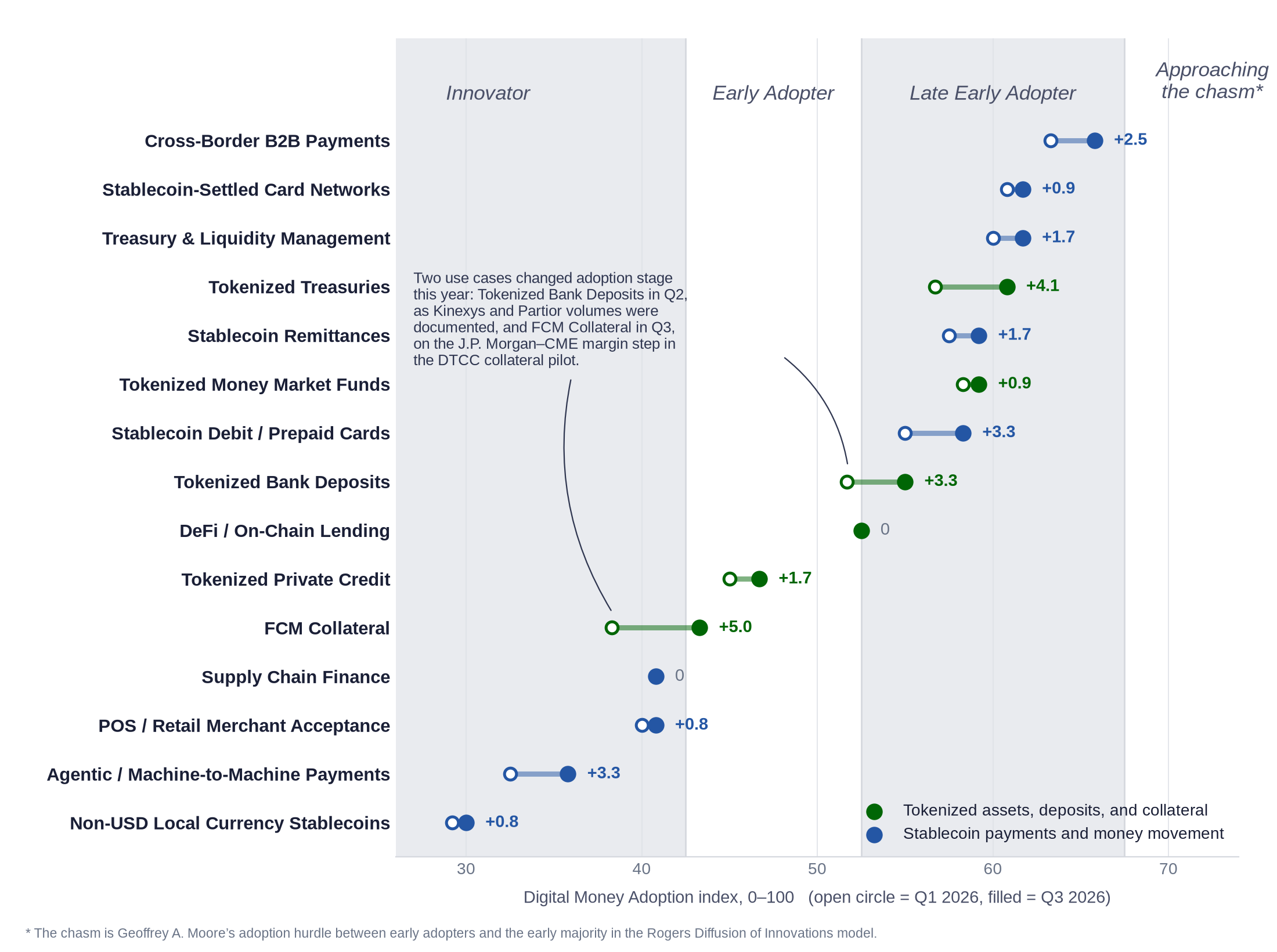
Reading the index. The index is the Field Guide’s six-dimension Digital Money Adoption composite, scored 1–10 and shown ×10 on a 0–100 scale. It is a presentation layer, not a new method; the published 1–10 scores on the Measurement & Analysis page are the scores of record. Evidence is counted in the quarter the research report documenting it was published, not the quarter a company announced it. Method: How the Adoption Score Works.
Report. Digital Money Adoption Dynamics, Q3 2026 is delivered to Field Guide subscribers; see the report page. Reporters and analysts may request the PDF directly from the contact below.
About the Stablecoin Field Guide
The U.S. Stablecoin Field Guide for Institutions is a research-based reference on stablecoin and tokenized-money adoption for corporate treasury, bank technology and business teams, payment and fintech practitioners, and institutional finance teams. It publishes a weekly news digest, a quarterly Digital Money Adoption Index across 15 use cases, a Solution Viability Matrix, a directory of 313 organizations, and a regulatory summary, built from a corpus of research reports sourced on the Research Sources page. The Field Guide is a FinTech Rising publication, written and edited by Collin Canright and published by Canright Communications, Chicago. He has served as a panelist covering stablecoins and tokenized deposits for Nacha Payments Innovation Alliance, econVue, and the National Association of Business Economists, Chicago chapter.
Contact
Collin Canright
collin@fintechrising.co · +1 773 426-7000
LinkedIn
Interviews, chart walk-throughs and data questions are welcome. Response within one business day.