Digital Money Use Case Adoption Measurement
Corporate treasury teams, global acquirers, and institutional asset managers have answered stablecoin and tokenized deposit core usefulness questions. They can solve solving high-friction operational problems, as evidenced by current use cases and production deployments.
According to our analysis of stablecoin and tokenized deposit research, five demand vectors, described below, are driving institutional adoption. Each Market Demand Vector is comprised of use cases; we have identified 15 primary use cases in various stages, from pilot to production.
To suggest which use cases are farthest along in terms of institutional adoption, the U.S. Stablecoin Field Guide has built a research-based Digital Money Adoption (DMA) score. Beyond that, we are tracking the overall solution viability of each market demand vector to further aid product marketing and corporate buying decisions.
The Five Market Demand Vectors
A demand vector as used here is a specific market force indicating a direction of corporate or institutional need—an operational pain point or economic opportunity that pulls a decision-maker toward a solution. These are not product categories, use cases, or technology features. Those all follow. Instead, they are the overarching reason a corporate or institutional organization deploys a stablecoin solution.
-
1. Cross-Border Payment Friction
The Efficiency vector. Correspondent banking is slow (1–5 days), expensive (2–8%), blocked after hours, and fails at emerging-market last mile. These frictions create structural demand for a faster, cheaper, always-on alternative for international B2B and treasury flows.
-
2. Treasury & Liquidity Efficiency
The Capital Optimization vector. Capital locked in prefunded correspondent accounts earns nothing. Intraday credit is unavailable on traditional rails, and idle overnight cash is unremunerated. These factors drive demand for programmable, 24/7 liquidity management tools.
-
3. Merchant & Commerce Settlement
The Accessibility & Margin vector. Card acquirer settlement takes 1–3 days and carries fees of 1.5–3.5%. In many instances, emerging markets are often blocked entirely. These realities create demand for instant, lower-cost, border-agnostic commerce settlement.
-
4. Programmable & Automated Payments
The Innovation & Automation vector. AP and AR automation, contractor payroll, escrow, and machine-to-machine payments all require logic embedded in the payment itself. These capabilities are not natively supported by traditional rails.
-
5. Institutional Capital Markets Infrastructure
The Market Infrastructure vector. About $40 billion in U.S. Treasury settlements fail daily. As a result, excess collateral sits unremunerated overnight; and derivatives and repo markets operate on “give-before-get”. These market mechanics can be eliminated by tokenized atomic settlement.
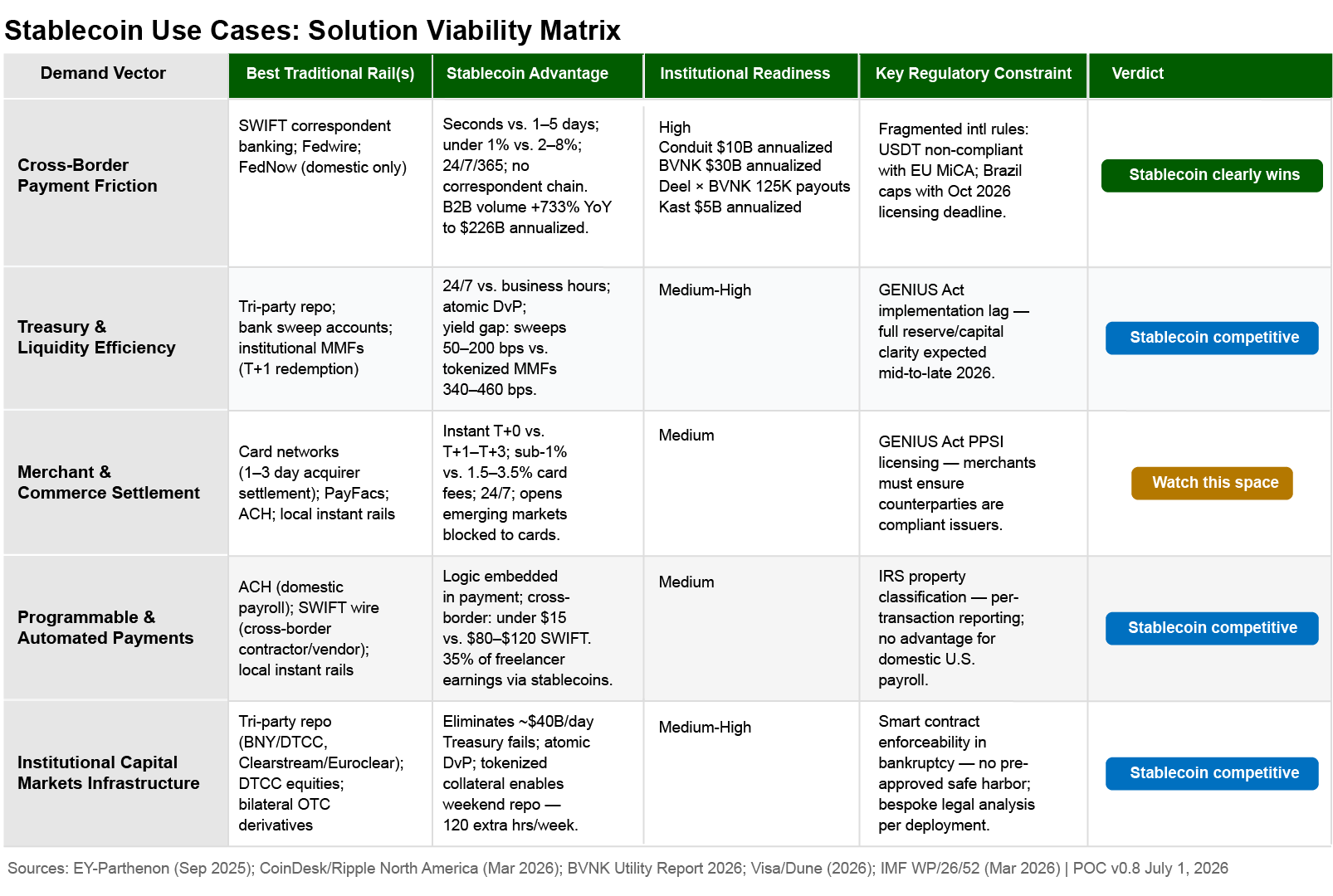
Digital Money Solution Viability Matrix
The DMA methodology applies a forced verdict to each market demand vector to give a research-based answer to the question: Is stablecoin infrastructure fit for purpose right now?
Corporate and Institutional Stablecoin Adoption Viability
Scoring Rubric
The Solution Viability Matrix is a weighted composite of five sub-scores, each independently rated 0–100.
| Sub-score | Weight | What It Measures |
|---|---|---|
| Publisher Consensus | 25% | How many primary sources (EY-Parthenon, Circle, Visa, BVNK, Chainalysis, Zero Hash, Deutsche Bank, Moody's, PitchBook, IMF, and others) treat this use case as production vs. pilot vs. speculative. Higher = more agreement. |
| On-Chain Evidence | 25% | Verifiable transaction volume from DefiLlama, Aavescan, Visa Onchain Analytics, and issuer disclosures. Higher = more real economic activity. |
| Deployment Count | 20% | Number of named institutions in production (not pilot). Sourced from the company directory and publisher case studies. |
| Regulatory Runway | 15% | Clarity of the U.S. and major-market regulatory posture for this use case. Higher = clearer path to deployment. |
| Buyer Signal | 15% | Presence in institutional treasury and payments RFPs, sales pipelines, and vendor case studies. Higher = active buyer demand. |
Composite Bands
- 80–100 — Production-Ready. Multiple institutions live. Buy or build now.
- 60–79 — Pilot-Mature. Real deployments exist but not standard. Evaluate for your context.
- 40–59 — Enabling Infrastructure. Rails exist; front-office use cases still emerging.
- 20–39 — Conceptual. Named projects but no volume. Watch, don't commit.
- 0–19 — Speculative. Concept only.
Digital Money Adoption Score
The Digital Money Adoption (DMA) score rates how far each of the 15 use cases has moved from pilot toward routine institutional use, on a scale of 1 to 10. It draws on six kinds of evidence: market volume, named institutions, regulatory clarity, infrastructure, business case and customer demand. A higher score means more documented institutional use, not a larger share of the market.
DMA Scores by Use Case, Q3 2026
All 15 use cases are listed in number order with their Q3 2026 scores (preliminary) and the change in points from Q1 2026. Scores are built from research reports grouped by publication quarter. Each demand vector comes from the deployment matrix; the Private Credit and Non-USD Stablecoin assignments are provisional. Likely buyers and sellers are editorial judgments drawn from the evidence base. How the score is built, including the adoption stages →
| # | Use case | Q3 | Increase Q1–Q3 (pts) | Definition | Likely buyers | Likely sellers | Demand vector |
|---|---|---|---|---|---|---|---|
| 1 | Cross-Border B2B Payments | 6.5 | 0.0 | Businesses pay overseas suppliers, contractors and partners in stablecoins instead of correspondent wires. Includes pre-funded account elimination and AP and payroll payouts. | Importers, exporters and multinationals; global payroll and AP platforms; mid-market corporates in hard-to-serve corridors | Stablecoin infrastructure providers (BVNK, Bridge/Stripe, Conduit, Zero Hash); banks with stablecoin services; Visa Direct | 1. Cross-Border Payment Friction |
| 2 | Treasury & Liquidity Management | 6.0 | 0.0 | Corporates and banks move cash 24/7 between their own entities and manage intraday liquidity with stablecoins or deposit tokens. | Multinational corporate treasurers; bank treasury and liquidity desks | Global transaction banks (JPMorgan Kinexys, Citi Token Services, HSBC); stablecoin issuers; treasury management system vendors | 2. Treasury & Liquidity Efficiency |
| 3 | Stablecoin-Settled Card / Payment Networks | 6.0 | 0.0 | Card networks and acquirers settle with issuers and merchants in stablecoins, including weekends, instead of fiat batch settlement. | Card issuers, acquirers and sponsor banks; payment facilitators | Visa, Mastercard; stablecoin issuers (Circle); settlement banks (Cross River, Lead Bank) | 3. Merchant & Commerce Settlement |
| 4 | Tokenized Money Market Funds | 6.0 | 0.0 | Money market fund shares issued and transferred on-chain, used for yield on idle cash and increasingly as collateral. | Corporate treasurers; crypto-native firms and stablecoin issuers parking reserves; brokers and exchanges taking collateral | Asset managers (BlackRock BUIDL, Franklin BENJI, Fidelity, WisdomTree, J.P. Morgan JLTXX); tokenization platforms (Securitize) | 2. Treasury & Liquidity Efficiency (also 5) |
| 5 | Tokenized Government Securities (Treasuries) | 6.0 | +0.5 | U.S. Treasuries and Treasury funds held and settled on-chain for collateral mobility, repo and atomic settlement. | Broker-dealers, banks and asset managers; clearing members; stablecoin issuers holding reserves | Asset managers and tokenization platforms (Ondo, Securitize, Franklin); market infrastructure (DTCC, Broadridge); custodian banks (BNY) | 5. Institutional Capital Markets Infrastructure (also 2) |
| 6 | Stablecoin Remittances | 6.0 | 0.0 | Consumers send money across borders in stablecoins, cashed out locally or held as dollars. | Migrant workers and their families, especially in emerging-market corridors; remittance companies seeking cheaper rails | Wallet and remittance apps; stablecoin infrastructure providers (Zero Hash, BVNK); local cash-out partners | 1. Cross-Border Payment Friction |
| 7 | Stablecoin-Based Debit / Prepaid Cards | 6.0 | +0.5 | Consumers spend a stablecoin balance anywhere a Visa or Mastercard card is accepted, converted at the point of sale. | Crypto holders and emerging-market consumers wanting dollar access; fintechs and wallets launching card programs | Card-program issuers (Rain, RedotPay, Ether.fi); BIN-sponsor banks; Visa, Mastercard | 3. Merchant & Commerce Settlement |
| 8 | DeFi / On-Chain Lending | 5.0 | 0.0 | Stablecoins lent and borrowed through on-chain protocols for yield, leverage or liquidity. | Crypto funds, trading firms and treasuries seeking yield; a few institutions testing permissioned pools | Lending protocols (Aave, Morpho, Sky, Maple); curators and institutional DeFi platforms | 2. Treasury & Liquidity Efficiency (also 5) |
| 9 | Tokenized Bank Deposits (Institutional) | 5.5 | +0.5 | Banks issue tokens representing their own deposits for programmable, always-on transfers among institutional clients. | Corporate and institutional bank clients; banks settling with each other | Global banks (JPMorgan JPMD/Kinexys, Citi, HSBC); bank networks (Partior, Swift shared ledger, The Clearing House plan) | 5. Institutional Capital Markets Infrastructure (also 2) |
| 10 | Supply Chain Finance | 4.0 | 0.0 | Programmable escrow, payment-on-delivery and smart-contract trade finance replace manual letters of credit and invoice financing. | Corporate procurement and trade teams; suppliers seeking faster payment; trade-finance banks | Trade-finance banks (UOB, ANZ); fintech platforms; smart-contract escrow providers | 4. Programmable & Automated Payments (also 5) |
| 11 | Tokenized Private Credit | 4.5 | 0.0 | Private-credit loans and funds issued as tokens, often as collateral in DeFi or distributed to wider investor pools. | Accredited and institutional investors; DeFi protocols wanting yield-bearing collateral; wealth platforms | Private-credit managers (Apollo, Fasanara); on-chain lenders (Maple, Figure); tokenization platforms (Securitize) | 5. Institutional Capital Markets Infrastructure (provisional) |
| 12 | FCM Collateral | 4.5 | +0.5 | Stablecoins and tokenized assets posted as margin at futures commission merchants and clearinghouses. | Futures traders, hedge funds and asset managers posting margin | FCMs and clearinghouses (CME); banks (J.P. Morgan); DTCC; tokenized-fund issuers (Franklin) | 5. Institutional Capital Markets Infrastructure |
| 13 | POS / Retail Merchant Acceptance | 4.0 | 0.0 | Merchants accept stablecoins directly at checkout, online or in store, with no card intermediary. | Online merchants with cross-border or crypto-native customers; high-fee merchant categories | Shopify with Coinbase and Stripe; crypto payment processors; wallet providers | 3. Merchant & Commerce Settlement |
| 14 | Agentic / Machine-to-Machine Payments | 3.5 | +0.5 | AI agents and software services pay each other automatically in small stablecoin amounts, for example for API calls or data. | AI developers and API/data providers; platforms deploying autonomous agents | Coinbase (x402), Stripe/Tempo, Cloudflare, Google; Visa and Mastercard agent protocols | 4. Programmable & Automated Payments |
| 15 | Non-USD Local Currency Stablecoins | 3.0 | 0.0 | Stablecoins backed by euros, Singapore dollars and other non-dollar currencies, for local payments and FX. | EU and Asia-Pacific businesses and banks needing local-currency settlement; FX desks | Regulated non-USD issuers (Circle EURC, StraitsX XSGD, SG-Forge); European bank consortia | 1. Cross-Border Payment Friction (provisional) |
Top Five Increases, Q1–Q3 2026
Five use cases rose between Q1 and Q3 2026, each by 0.5 points; the other ten held level.
| # | Use case | Pt increase | Definition |
|---|---|---|---|
| 5 | Tokenized Government Securities (Treasuries) | +0.5 | U.S. Treasuries and Treasury funds held and settled on-chain for collateral mobility, repo and atomic settlement. |
| 7 | Stablecoin-Based Debit / Prepaid Cards | +0.5 | Consumers spend a stablecoin balance anywhere a Visa or Mastercard card is accepted, converted at the point of sale. |
| 9 | Tokenized Bank Deposits (Institutional) | +0.5 | Banks issue tokens representing their own deposits for programmable, always-on transfers among institutional clients. |
| 12 | FCM Collateral | +0.5 | Stablecoins and tokenized assets posted as margin at futures commission merchants and clearinghouses. |
| 14 | Agentic / Machine-to-Machine Payments | +0.5 | AI agents and software services pay each other automatically in small stablecoin amounts, for example for API calls or data. |
Product and Payment Solution Strategies
Given the research views above, it is clear that digital money solutions can provide corporations and financial institutions with some clear advantages. Decisions on which solutions to offer or adopt should be guided by how your clients or organization is affected by which market demand vectors and what use cases can provide the most value.
The answer is not the same for every financial institution, payment provider, or corporation. A regional bank with a commercial lending portfolio heavy in manufacturing and trade finance has different near-term exposure than one serving technology companies and digital marketplaces. A bank active in repo and collateral management is closer to the capital markets infrastructure vector than one whose institutional exposure is primarily in commercial deposits.
The common thread: the digital finance infrastructure layer, of which digital money solutions are one part, is built and operated outside most banks’ current product roadmaps. Fintechs, payment networks, and Tier 1 institutions have already committed capital and engineering resources to these rails.
Resistance is futile, you may conclude. When to engage and how to engage are more important considerations at this point than whether the technology is real.
About the Analysis
Our data come from our analysis of publicly available research, grounded in live deployments, measured volumes, and documented institutional adoption as of Q2 2026.
The research framework is instrument-agnostic. Stablecoin, tokenized deposit, and wholesale CBDC use cases can all satisfy requirements in the five demand vectors because a buyer’s problem is the same regardless of who issues the instrument.
For the Solution Viability Matrix, each demand vector has a distinct evidence base, a set of named adopters, and implications for bank and sell-side product strategy. Verdicts on each vector are forced into one of the following options: - Stablecoin clearly wins - Stablecoin competitive - Watch this space - Traditional rail still dominates
This prevents hedged non-answers. Where a single vector splits across corridors or use types, the primary verdict reflects the strongest institutional evidence, with the secondary case noted.
Contact collin@canrightcommunications.com with questions or to suggest other data sources.
Related Pages
- Production & Pilot Maturity Matrix — Documents named deployments with volumes, counterparties, and source citations for all 17 use cases across the five demand vectors.
- Solution Viability Research — Provides detailed demand vector tables with evidence by use case, viability verdicts, key gating factors, and eight emerging use cases flagged for v0.9 re-evaluation.
Page History
17 reader-facing changes since 2026-07-11; last change 2026-10-15 (v1.1).
Show all changes
| Date | Release | Change |
|---|---|---|
| 2026-10-15 | v1.1 | v1.1 Q1–Q3 2026 DMA scores |
| 2026-10-15 | v1.1 | DMA score tables use the green header style and table type size of How the Adoption Score Works |
| 2026-10-15 | v1.1 | Q3 2026 DMA score tables on Measurement & Analysis; Solution Viability Matrix moved after the demand vectors; Stablecoin v. ACH rail landscape image path fixed |
| 2026-10-14 | v1.0.1 | remove remaining v0.9 score references (Moore and CD pop-ups, buyer personas, overview, roadmap) |
| 2026-10-13 | v1.0.1 | retire v0.9 DMA scores from the site; archive v0.9 page in research/archive; redirect old URL |
| 2026-10-13 | v1.0 | v1.0 restructuring, source verification and quarterly Research Sources |
| 2026-10-13 | v1.0 | one adoption scale; Moore stages aligned to cohort bands (Approaching Chasm from 7.0, Early Adopter 4.5-5.0, Innovator up to 4.0); penetration evidence added; v0.9 score chart replaced with table |
| 2026-10-13 | v1.0 | move Moore adoption life cycle and DMA concept map to new Methodology page; plain-language score summary on Measurement & Analysis |
| 2026-10-12 | v1.0 | Glossary page consolidating the Solution Viability glossary (43 terms; Term, Definition, Type) |
| 2026-09-14 | v0.9 | Release change to v0.9. Added DMA score, combined Use Cases with Adoption, rewrote the score overview page, updated roadmap, and posted the 09-14 News Digest. note to home plus roadmap changes |
| 2026-09-08 | v0.9 | Fixed Use Cases Overview typo |
| 2026-09-08 | v0.9 | Updated Use Cases Overview with DMA score and added images to News Digest |
| 2026-07-12 | v0.8 refresh | Edits to Use Cases Overview |
| 2026-07-12 | v0.8 refresh | Edits to Use Cases Overview and ACH graphic |
| 2026-07-12 | v0.8 refresh | Added Use Case Overview and a Roadmap section. Updates Use Case and Adoption articles. |
| 2026-07-12 | v0.8 refresh | Added Use Case Overview, Updated Use Case pages, and a Roadmap section. |
| 2026-07-11 | v0.8 refresh | Added Use Case Overview and updated existing pages |
Infrastructure and formatting commits are omitted. Release-level detail is in the Release Notes.